About Battery Data Alliance
Building sustainable open source software, best practices, and delivery standards for the battery industry.
Our Mission
The Battery Data Alliance (BDA) is a Linux Foundation Energy project. Battery data comes from everywhere — lab equipment, published research, battery management systems, field deployments, simulators — but none of it works well together. Different formats, different processes, different assumptions. BDA creates open standards and software to give the industry a common foundation — not just for sharing data, but for building the insights, analytics, and intelligence on top of it. Better data infrastructure means better decisions, faster.
Our projects tackle the problems that slow the whole industry down — from data conversion and discovery to equipment control and reproducibility. The goal: let researchers, manufacturers, and engineers focus on building better batteries, not fighting their tools.
of decision-makers cite data complexity as a barrier to AI adoption (Forrester, 2024)
estimate months to years of time savings from standardized datasets (Forrester, 2024)
open source repositories and growing
Our Initiatives
We're tackling battery data challenges through two complementary efforts.
Data Specification
One format for all battery data — from lab cyclers to field deployments to simulation output.
- Share data across teams and organizations
- Datasets formatted so machine learning models can use them directly
- Build tools that work with data from any source
Battery Data Format
The open standard and Python package for converting, validating, and working with battery data.
BDF Ontology
Structured vocabulary so software can automatically find and understand battery data.
BDF Datastore
Community repository of open battery test datasets, ready for analysis and ML training.
Cycler Control
Control your battery test equipment programmatically. Automate experiments, run tests remotely, and integrate with your workflow.
- Run experiments from Python scripts
- Monitor and control tests remotely
- Build automated testing pipelines
PyMacNet
Python interface for Maccor cyclers. Start, stop, and monitor battery tests programmatically.
PyCTIArbin
Python interface for Arbin cyclers. Full control over your Arbin equipment from code.
Why Support Battery Data Alliance
Innovation
Your data works with everyone else's. ML models train on larger, combined datasets. Researchers skip weeks of format conversion.
Ecosystem
Equipment vendors can export BDF natively. Software tools can read data from any cycler. Labs can share results without custom scripts.
Future
Help define the standard before it defines you. Early supporters shape the format that the industry will adopt.
Transparency
Standardized data enables auditable battery testing records — critical for sustainability claims, lifecycle analysis, and regulatory compliance.
Voices from the Community
Researchers and industry leaders have been calling for better battery data practices.
“Having universal standards for data management for each segment of the battery community is required for data creation to unlock the power of AI algorithms.”
— Ward et al., Joule (2022)“We're trying to energize and organize the battery community to contribute their data, whenever possible to as many researchers as possible, to enable powerful data science methods to catalyze breakthroughs.”
— Noah Paulson, Argonne National Laboratory“57% of decision-makers cite deciphering complex relationships in multiparameter datasets as a significant barrier to AI-powered battery validation.”
— Forrester, AI for EV Battery Validation (2024)Industry Recognition
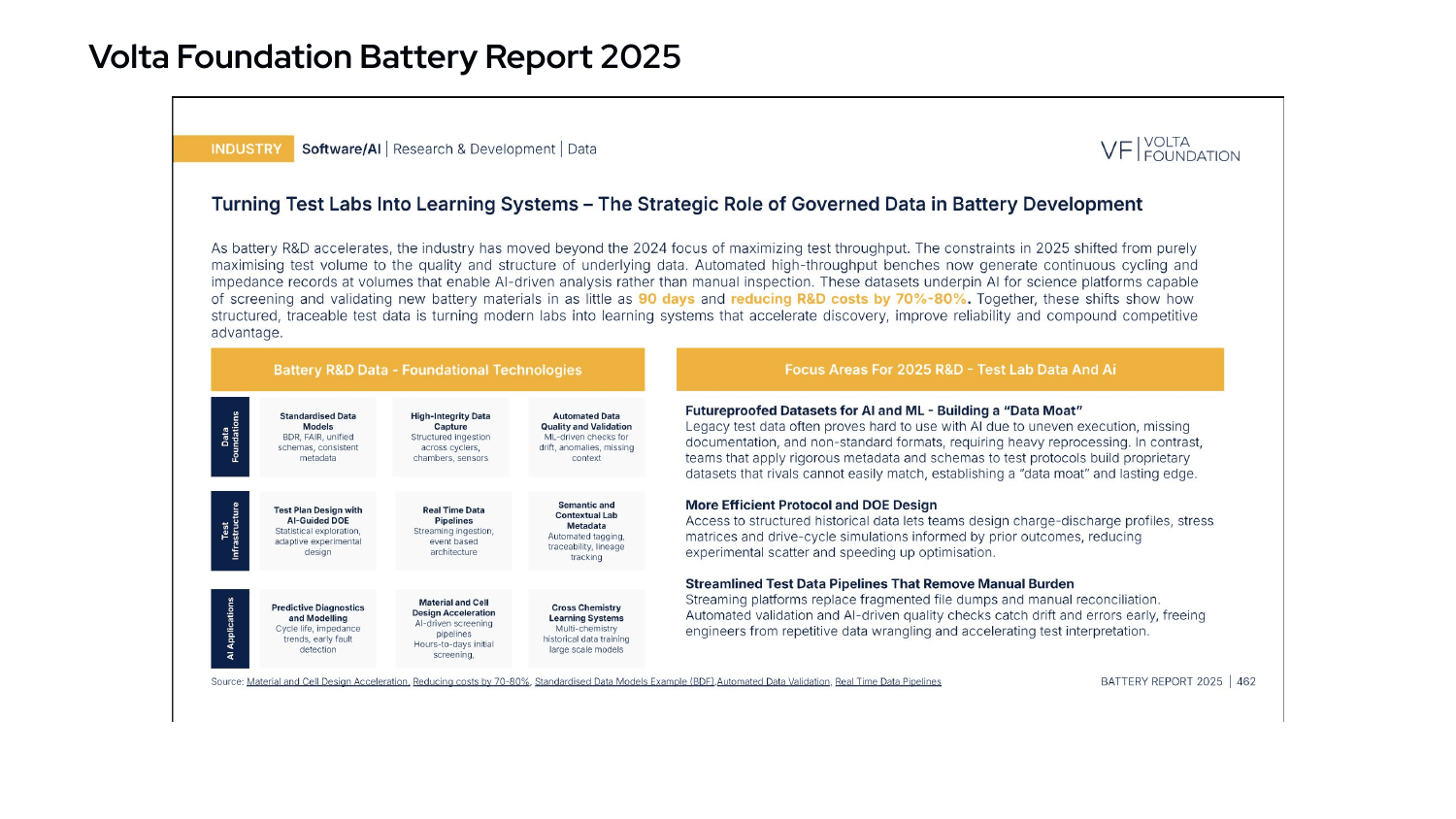
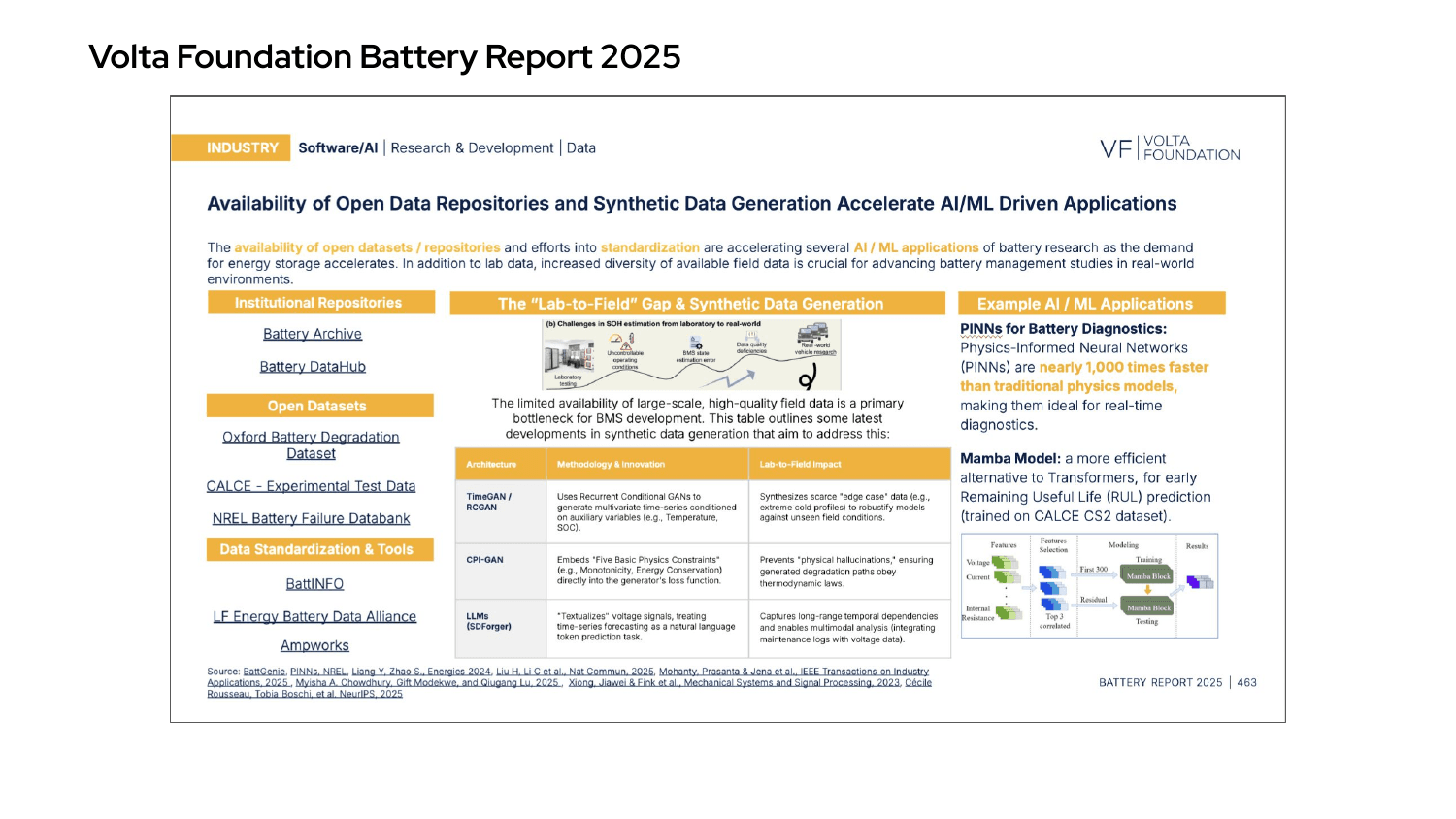
Featured in the Volta Foundation Battery Report
Source: Forrester, AI for EV Battery Validation (2024) · Anaconda, State of Data Science (2022)
A Linux Foundation Energy Project
The Battery Data Alliance is hosted by LF Energy, a Linux Foundation project focused on accelerating the energy transition through open source. This provides us with robust governance, neutral hosting, and access to the broader open source ecosystem.
Learn more about LF EnergyGovernance
Open Source License
All BDA projects are released under the Apache 2.0 license, ensuring they can be freely used, modified, and distributed by anyone.
Community Driven
Development is guided by the needs of the community. Anyone can contribute code, documentation, or ideas through our GitHub repositories and discussion forums.
Join the Alliance
Whether you want to contribute code, share data, or help shape the future of battery data standards, there's a place for you in the BDA community.